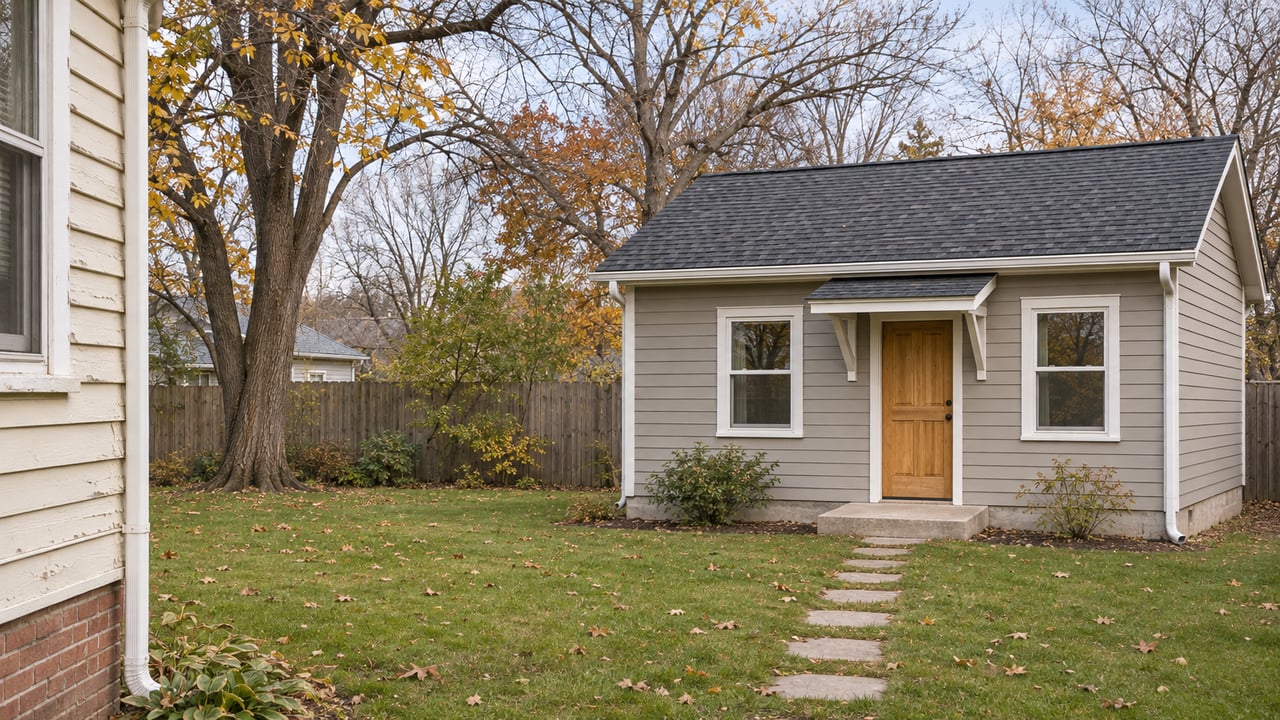
A buyer looking at an older Iowa City house sees a lot size on the listing sheet and a detached garage out back. What the listing doesn't show is how much the rules for that back corner have changed. Since July 2025, Iowa law has required Iowa City to allow at least one accessory dwelling unit on a lot with a single-family home, and it bars the city from setting the old conditions that used to make those units hard to build.
The city's own numbers show the change taking hold. Iowa City's 2025 Residential Development Report, released this summer, counts 8 accessory dwelling units permitted in 2025. Across the ten years from 2015 through 2024, the city permitted 8 in total. During the same year, almost no new land was being prepared for houses.
The Year the Permits Moved Into Existing Lots
The report's permit table counts dwelling units, not permit documents. Here is how the last three years compare:
| Dwelling units permitted | 2023 | 2024 | 2025 |
|---|---|---|---|
| Accessory dwelling units | 1 | 0 | 8 |
| Duplex units | 4 | 4 | 18 |
| Single-family detached | 50 | 95 | 61 |
| Multi-family | 505 | 46 | 90 |
The 18 duplex units in 2025 are the most in the report's eleven-year table, which starts in 2015. City staff wrote that duplex units beat both the five- and ten-year averages in 2025, while single-family detached permits came in below both. The overall total was small. Iowa City permitted 177 units of all kinds in 2025. That small total is why the backyard and duplex numbers matter. Next to a few hundred units a year, 26 units permitted on lots that already existed is a real share.
Why the Subdivision Pipeline Changes the Math on an Older Lot
The report opens with land. Subdivision activity in 2025 fell far below average, single-family lots dropped 93% below the five-year average, and no new single-family or duplex lots were platted in 2025.
Staff estimate the city has about a three-year supply of single-family lots at recent permit levels. They also say many of those lots have sat vacant for decades because something about them makes them hard to build on, and that the supply would shrink quickly if permitting returned to normal levels.
The long-term gap is larger. The 2025 Comprehensive Plan Update projects demand for about 9,098 new dwellings in Iowa City between 2025 and 2050. If permit trends from 2020 through 2025 continue, the city expects to meet 86% of that demand and fall about 1,250 units short.
When new lots stop coming, the extra housing has to fit on land that is already part of a neighborhood. For a buyer, that changes what an established lot in the older parts of town is. It is no longer just yard. It is one of the few places in the city where a new dwelling can still legally be added.
Iowa City Loosened Its Own Rules First, and Little Changed
The 2025 jump wasn't the first attempt to unlock these lots. Iowa City's 2023 housing-choice amendments allowed duplexes in more of the lower-density single-family zones, ending the old corner-lot-only rule. The Gazette reported that city staff estimated as many as 2,900 lots could take a duplex through gradual conversion. A 2026 staff memo confirms that duplexes are now allowed mid-block in the RS-5 and RS-8 districts.
The permit table barely moved afterward. The city recorded 4 duplex units in 2023 and 4 in 2024, then 1 ADU and 0 ADUs in those same two years. The slow pace goes back further than that. When the city began its review in 2023, the Daily Iowan reported city staff's figure of 52 ADUs built in roughly three decades, out of about 10,000 eligible units. In that same story, local construction-company owner Andy Martin said the ADU requests he heard usually involved family members and aging in place, and that easing parking and design standards could lower costs.
During that 2023 debate, the Daily Iowan also reported that the Planning and Zoning Commission voted 4–3 to recommend every amendment except eliminating the owner-occupancy requirement. The state settled that question two years later.
What Iowa's 2025 Law Took Off the Table
Senate File 592 was signed May 1, 2025, and took effect July 1, 2025. It requires cities to allow at least one ADU on the same lot as a single-family home. Local rules that conflict with it are void. Under the statute, a city cannot:
- set placement or design rules for an ADU that are stricter than those for a single-family home, including setbacks, height, lot size, coverage and density
- require parking beyond what the main house needs, or charge a fee instead
- require the owner to live on the property, or require a family or employment tie between the two households
- require separate utility lines when full utility access can be provided
- apply stricter rental rules, different impact-fee structures, or extra street and sidewalk improvements
The law also says a permit that meets the rules must be approved without discretionary review or a hearing, on the city's normal single-family timeline, and any denial must come in writing with reasons.
The law took effect in the middle of 2025, the same year Iowa City's ADU count went from 0 to 8. The city's report does not attribute the increase to the law.
Iowa City brought its code in line in two steps. Ordinance 26-4976 updated the main ADU section. Ordinance 26-4989, passed June 16, 2026, removed the older carriage-house standards from the Form-Based Code and matched the code to a second state law. The current version of Iowa City Code §14-4C-2A allows one ADU on a lot with a single-family home. It must be a complete, independent dwelling with a kitchen, a bathroom and an exterior entrance, under common ownership with the main house. Its floor area can be up to 1,000 square feet or 50% of the main house, whichever is larger, with unfinished basements excluded from that calculation. The code treats an ADU as an accessory use. A duplex is a different category, defined as two principal units in one building on one lot.
The Historic District Carve-Out, Tested on the Northside
Much of Iowa City's older housing sits in historic districts, so the second law matters there. Senate File 2369, approved April 9, 2026, limits the ADU requirement to zones where single-family homes are allowed. It defines the main house's size as gross living area, not counting garages, decks or unheated porches. It also lets historic areas regulate an ADU when the city or its preservation commission finds the unit would be incongruous with the area's historic, architectural, archaeological or cultural character and records why.
The Northside saw one of the first test cases. On September 10, 2026, the Iowa City Historic Preservation Commission took up an application on East Davenport Street in the Northside Historic District. According to the commission's minutes, it proposed replacing a detached garage from around 1930, behind a Queen Anne house from around 1898, and building a new two-car garage with an ADU on the upper floor.
Staff reviewed it against the city's preservation guidelines. Those call for new outbuildings to sit behind the main house, stay clearly smaller and plainer than it, reflect its style, and use no vinyl, aluminum or false-masonry siding. Staff found the design met those tests and asked for simple wood trim at least four inches wide. The commission approved it 7–0.
This ADU went through historic design review. In this case, the review was about how the unit should look and where it should sit. Whether the unit should exist at all wasn't in question.
Questions to Bring to an Older Iowa City Lot
The local real estate and building trades have been preparing for this. The Iowa City Area Association of Realtors held an ADU course in Coralville on September 30, 2025, for agents, builders and community leaders. It covered eligibility, approval, financing, design, permitting and construction, with partners including the Greater Iowa City Area Home Builders Association and the Johnson County Affordable Housing Coalition. When you're weighing an older house, the research above points to a few concrete questions:
- Which zone is the lot in? The 2023 duplex changes apply mid-block in RS-5 and RS-8, and the state ADU rule applies wherever a single-family home is a principal use.
- Is it in a historic district? The Davenport Street proposal went before the Historic Preservation Commission.
- How large is the house's gross living area? SF 2369 measures it without garages, decks or unheated porches, and that figure sets the 50% option.
- What is planned for the existing garage? On the Northside, replacing an old garage was how the ADU proposal took shape.
This post is general information, not legal, tax or financial advice, so confirm your property's zoning and requirements with the City of Iowa City and the right professionals before you rely on any of it.
A Few Straight Answers
Can Iowa City require me to live on the property if I add an ADU? SF 592's text bars cities from imposing owner-residency requirements and rules about who the occupants must be.
Does the state law let me turn any house into a duplex? The state statute covers one accessory unit with a single-family home. Duplex rules come from Iowa City's own zoning.
How big can an ADU be? Iowa City's code sets the limit at 1,000 square feet or 50% of the main house, whichever is larger, with unfinished basements excluded from the calculation.
If you're comparing an older Iowa City house with a garage out back to a newer home on a smaller lot, the agents at Blank & McCune, The Real Estate Company can help you look up its zoning and district before you make an offer. Find your agent and bring us the address.